uPVC vs. Wood Windows in Hyderabad: An Honest, Long-Term Comparison
Compare uPVC and traditional wood windows in Hyderabad based on durability, maintenance, cost, heat control, noise reduction, and long-term performance before choosing the right option for your home.
uPVC windows generally outperform wood in Hyderabad’s climate, resisting heat, humidity, and termites while needing far less maintenance over 15–20 years. Wood offers a natural look and can last if properly maintained, but requires regular repainting, sealing, and termite treatment. For most homes, uPVC is the more practical, cost-effective long-term choice.
The Question Every Hyderabad Homeowner Eventually Faces
At some point, almost every homeowner in Hyderabad ends up replacing their windows—and almost every one of them asks the same question: should I go with traditional wood frames, or switch to uPVC? Search online and you’ll find no shortage of opinions, but most fall into one of two camps: vague generalities or thinly veiled sales pitches.
Here’s the more useful framing. Neither material is universally “better.” Both can perform beautifully for decades, and both can fail prematurely. What actually determines the outcome is how well the material matches your building’s exposure, your climate conditions, your willingness to maintain it, and your budget over a realistic 10-to-20-year window.
This guide is meant for homeowners researching uPVC windows in Hyderabad who want a grounded, detailed comparison rather than marketing copy.
uPVC and Wood: Two Fundamentally Different Materials
uPVC (Unplasticised Polyvinyl Chloride) is a dense, rigid polymer. It doesn’t absorb moisture, doesn’t rust or oxidise, and barely changes shape with temperature swings. A typical uPVC frame is built as a hollow extrusion containing several internal chambers—usually between three and six—separated by walls of the same material. This multi-chamber design gives the frame strength and insulation without needing solid material throughout.
Wood frames are the opposite: solid or laminated natural timber. Performance varies enormously depending on the species—hardwoods like teak and sal hold up far better than softwoods such as pine. But no matter the species, wood retains its natural grain structure, which means it will always absorb some moisture and respond dimensionally to humidity.
These aren’t just academic differences. They directly determine how each material survives Hyderabad’s yearly climate cycle: punishing pre-monsoon heat above 40°C, a humid and wind-driven monsoon, and a mild but temperature-swinging winter—repeated, year after year.
How Each Material Handles Hyderabad's Climate
The annual cycle is brutal on building materials. From March to May, dry heat regularly pushes past 40°C. Then the monsoon arrives with sustained humidity, driving rain, and sudden temperature drops. Winters that follow are mild on the surface but bring noticeable day-to-night swings.
For wood, this cycle is the root cause of long-term decline. During the monsoon, timber absorbs moisture and swells. As it dries out in summer, it contracts again. Repeat this enough times and you get micro-cracks in the finish, loosened joints at the corners, and eventually warping severe enough to break the seal. None of this happens overnight—it’s gradual—but the end result is predictable: without exceptional materials and diligent upkeep, wooden windows in Hyderabad typically show real performance decline within 8 to 12 years.
uPVC experiences the same climate quite differently. Its thermal expansion is so minimal that, across Hyderabad’s temperature range, dimensional changes are essentially negligible. There’s no moisture absorption, so there’s no swelling, no shrinking, and no joints loosening from humidity. The gaskets that form the weatherproof seal stay under steady compression year-round—which is exactly why uPVC windows tend to hold their original performance much longer with little to no intervention.
Which Lasts Longer—uPVC or Wood?
To answer this honestly, you need to separate two different ideas of “lasting.”
Structural lifespan is how long the material physically holds its shape and load-bearing function. High-quality hardwood—teak or sal—can be remarkably durable here; well-treated teak can last 40 to 50 years structurally. Quality uPVC is typically rated for 25 to 35 years.
Performance lifespan is how long the window keeps sealing, insulating, and operating properly without major intervention. This is where the gap becomes much more pronounced. Wood windows in Hyderabad usually need repainting, re-sealing, or hardware replacement within just 3 to 5 years—skip that, and performance drops noticeably. uPVC windows, on the other hand, tend to hold close to their original performance for 15 to 20 years with nothing more than routine cleaning.
For most households, performance lifespan is what actually matters day to day. A window frame that’s technically still standing but leaks every monsoon isn’t doing its job—regardless of how solid the wood underneath might be.
The Real Cost Comparison: Upfront vs. Long-Term
A common assumption is that wood is the cheaper option. That used to be true for basic softwood frames—but quality hardwood, the only fair comparison against quality uPVC, is now often more expensive to buy and install.
Here’s an indicative breakdown for the Hyderabad market:
|
Factor |
Quality Hardwood (Teak) |
Quality uPVC (5-chamber DGU) |
|
Initial cost per sq ft |
₹900 – ₹1,800 |
₹700 – ₹1,400 |
|
Painting/polishing (Year 3–4) |
₹150 – ₹300 per window |
Not required |
|
Termite treatment (every 3–5 years) |
₹200 – ₹500 per window |
Not required |
|
Hardware replacement (Year 7–10) |
₹300 – ₹600 per window |
Minimal |
|
Re-sealing (every 5 years) |
₹100 – ₹250 per window |
Periodic sealant check |
|
Estimated 15-year total cost |
₹1,700 – ₹3,500 per sq ft |
₹800 – ₹1,600 per sq ft |
Figures are indicative estimates for the Hyderabad market and will vary based on project size, building access, and exact specifications.
That maintenance gap is the part most people underestimate when they’re comparing quotes—and it’s also the part salespeople on either side rarely walk you through in detail.
Comfort: Heat and Noise
On thermal performance: wood is naturally insulating, and a solid teak frame does offer some real resistance to heat transfer. But the frame is only a small part of a window’s total surface area—the glass is where most heat moves in or out. A single-glazed wooden window will lose this contest to a uPVC frame fitted with a double-glazed unit (DGU), no matter how good the timber is. For homes in areas like Gachibowli, Kondapur, or HITEC City, where west-facing rooms take a beating from the afternoon sun, glass specification matters more than frame material—and uPVC with Low-E DGU outperforms wood with single glazing across every meaningful metric.
On sound: the two frame materials perform fairly similarly on their own. Multi-chamber uPVC profiles offer a slight edge over hollow wood frames at comparable glass specs, but the difference only becomes meaningful in genuinely loud environments. For apartments near main roads, flyovers, or in Hyderabad’s denser neighborhoods—which describes a large share of the city’s housing—acoustic-grade DGU or laminated glass paired with a uPVC frame is the more practical choice.
Maintenance: What Each Material Actually Demands
Wood, in Hyderabad, requires: an annual pre-monsoon inspection of the surface finish; repainting or polishing at least every 3 to 4 years; termite treatment every 3 to 5 years (a real concern, especially in older residential layouts); joint re-sealing every 4 to 5 years; and yearly hardware lubrication and adjustment.
uPVC, in Hyderabad, requires: occasional wiping down of frames and sill tracks; clearing the weep holes (drainage slots in the sill) before monsoon—roughly five minutes per window; checking and refreshing the perimeter sealant between frame and wall every 4 to 5 years; and yearly hardware lubrication.
For a home with 10 to 15 windows, that difference compounds significantly over a decade—both in time and in money—and it’s something many buyers don’t fully account for at the point of purchase.
What About Looks?
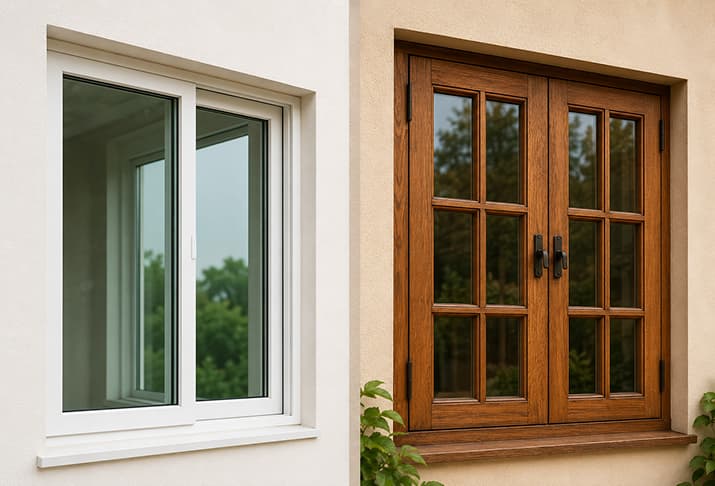
Wood has one advantage that’s hard to argue with: the warmth and natural grain of real timber simply isn’t something manufactured materials fully replicate. For heritage homes, traditional architecture, luxury bungalows, or any space where the window frame functions as a visible design feature, quality teak or engineered wood still has an aesthetic edge.
That said, modern uPVC has closed much of that gap. Wood-effect laminate finishes now closely mimic real timber grain, colour options have expanded well past the plain white frames that once defined uPVC in India, and slimmer sightline profiles have addressed the bulky look older systems were criticised for. For most apartments and villas in Hyderabad—where the window frame is functional rather than decorative—contemporary uPVC looks perfectly at home.
When Wood Is Still the Right Call
To be fair, there are scenarios where wood genuinely makes sense:
- The property is a heritage or period-style home where traditional aesthetics aren’t negotiable
- The windows sit in sheltered, low-exposure interior courtyard positions
- The homeowner has both the discipline and the budget for ongoing maintenance
- The design uses window frames as a visible interior feature
- A project needs custom profile shapes that standard uPVC extrusions can’t produce
And wood is usually a poor fit when:
- The property faces southwest or west and takes direct monsoon exposure
- Termite activity is a known issue in the area or building
- Regular maintenance isn’t realistic for the homeowner
- The windows are above the 4th floor, where access for upkeep becomes difficult and costly
- Budget forces a choice between softwood (which won’t last) and quality uPVC
What Installers See After 8–10 Years
A familiar pattern shows up again and again with replacement jobs. Homeowners chose wood years ago because they liked the look, without planning for the upkeep. Now the windows jam during monsoon, two or three frames show termite damage, and peeling paint is trapping moisture against the wall. By the time everything is replaced—including repairs to the surrounding wall—the total cost often exceeds what quality uPVC would have run from the start.
The homeowners happiest with their wood windows, by contrast, are the ones who treated them almost like a garden: scheduled inspections, quick responses to small issues, and a budget set aside for upkeep. Wood is a living material—it rewards attention and punishes neglect.
uPVC, by comparison, is far more forgiving of a missed maintenance cycle. That doesn’t mean it needs zero attention—blocked weep holes and degraded perimeter sealant are real issues—but the consequences of skipping a cycle are much less severe.
One more thing professionals consistently notice: glass specification is the single most underrated factor in window performance. Whatever frame material you choose, insisting on a properly specified DGU suited to your building’s orientation will improve comfort and energy efficiency more than the frame debate ever will.
A Simple Framework for Deciding
- Assess your exposure. South- or west-facing windows with direct weather → uPVC strongly preferred. North- or east-facing, sheltered positions → either works. Heritage or low-rise traditional architecture → wood is viable if maintenance is budgeted for.
- Assess your maintenance appetite. Comfortable with annual inspections, 3-year maintenance cycles, and pest treatment costs → either works. Want minimal ongoing effort → uPVC.
- Assess your budget horizon. Looking only at 5-year cost → wood may seem cheaper for basic grades. Looking at 10–15 years → uPVC is consistently more cost-effective. Premium hardwood with a genuine maintenance budget → roughly comparable to quality uPVC over 15 years.
- Assess your aesthetic priorities. Frame as a key design element, natural material preferred → wood, with a real maintenance plan. Performance and longevity first, looks second → uPVC. Modern look acceptable, wood-effect finish is fine → uPVC with wood-effect laminate.
- Don’t skip the supplier and installer check. Both materials fail when poorly installed. A high-quality uPVC system installed badly will underperform a well-installed wood system—and vice versa. Installation quality matters as much as the material itself.
The Bottom Line
There’s no single correct answer in the uPVC-versus-wood debate—only the right answer for your specific building, climate exposure, maintenance capacity, and timeline.
For most homes in Hyderabad—especially apartments, newer villas, and properties with significant road exposure or high-floor positions—uPVC windows with a quality profile system and the right glass specification tend to be the smarter long-term investment. They offer steady performance, lower lifetime maintenance costs, and reliable protection through every monsoon without demanding constant attention.
For heritage properties, genuine aesthetic priorities, and homeowners willing to maintain natural materials properly, quality hardwood remains a perfectly legitimate choice—as long as the budget reflects what it actually takes to keep it performing well.
Whichever way you lean, the supplier and installer you choose matter just as much as the material. Look for Window Suppliers in Hyderabad who provide written profile specifications, offer both product and installation warranties, and have a proven track record with buildings similar to yours.
For tailored guidance on uPVC windows built for Hyderabad’s climate, reach out to WindoorKrafts to speak with a window specialist.