
Best uPVC Windows for Monsoon Season in Hyderabad
Hyderabad’s monsoon needs windows built for heavy rain, wind and humidity. This guide explains why uPVC works better, what features to check, costs, supplier tips and a buyer’s checklist clearly well.
The best uPVC windows for Hyderabad’s monsoon use a 60–70mm profile with at least 3–5 chambers, EPDM rubber gaskets, and double-glazed units to resist wind-driven rain and humidity. Casement or tilt-and-turn styles perform best, while proper weep holes and sealant at the frame-wall junction prevent leaks and water damage.
Why Do Windows Leak or Fail During Monsoon?
Hyderabad’s monsoon is not gentle. Between June and October, the city receives an average of 700–800 mm of rainfall, often arriving in sudden, high-intensity bursts. Winds can reach 60–80 km/h during pre-monsoon storms. For homeowners whose windows were installed without the right material, sealing system, or frame depth, this season is not just uncomfortable — it is expensive.
Water damage from poor windows is one of the most underreported maintenance costs in Hyderabad apartments and villas. Seepage stains walls. Swollen frames jam shut. Rusting hardware becomes a security risk. And yet most people only think about their windows when the rains arrive.
This guide is for anyone who wants to make a smarter, more informed choice about uPVC windows in Hyderabad — before the next monsoon season, not after.
What Makes a Window "Monsoon-Ready"?
A monsoon-ready window is one that maintains a complete, unbroken seal between your interior and the outside environment — under sustained rain, wind pressure, and temperature fluctuations — without any mechanical failure, water ingress, or frame movement.
This is about more than just material. It involves multi-chamber profile construction, EPDM rubber gaskets, correctly specified glass panels, hardware rated for tropical climates, and installation executed to precise tolerance standards. Miss any one of these, and the window fails regardless of what the brochure says.
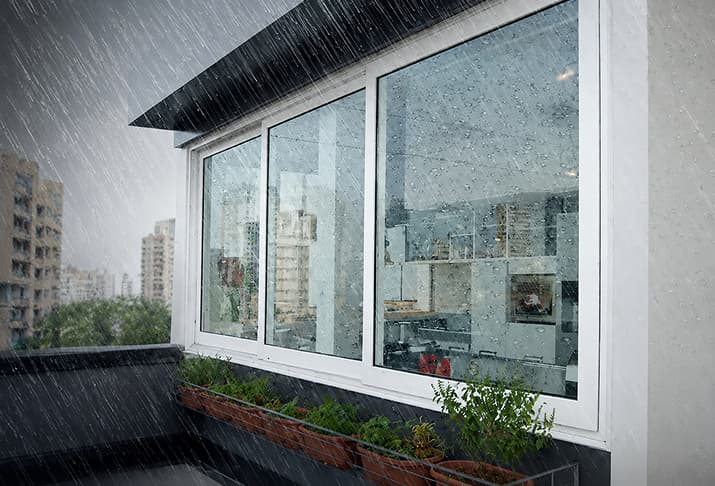
Why Does Hyderabad's Monsoon Demand Specific Window Design?
Hyderabad’s monsoon is climatically distinct from coastal cities like Chennai or Mumbai. The city sits on the Deccan Plateau at an elevation of roughly 500 metres, which means rainfall arrives in intense, wind-driven bursts rather than steady horizontal sheets. This wind-driven rain is the most damaging pattern for windows.
Standard windows — including basic uPVC units not designed for Hyderabad’s conditions — often fail because:
- Wind pressure variation creates suction and push forces on window seals simultaneously
- Temperature swings between pre-monsoon 40°C+ heat and cooler monsoon air cause rapid thermal expansion and contraction in frames
- High dust accumulation (Hyderabad has significant construction activity in areas like Gachibowli, Kokapet, and the ORR corridor) means drainage channels on window sills clog faster than in other cities
- Humidity persists even between rain events, encouraging mould growth around poorly sealed frame joints
A window designed for Hyderabad’s monsoon must account for all of these simultaneously, not just rain resistance alone.
Why uPVC Windows Are Better in Rain
uPVC stands for Unplasticised Polyvinyl Chloride — a rigid, dense polymer that is fundamentally non-absorbent. Here is what that means practically:
Material | Water Absorption | Rust/Rot Risk | Thermal Expansion | Maintenance Frequency |
Wood | High | Rots, attracts termites | High | Every 1–2 years |
Steel/Iron | None | Rusts at joints and hinges | Medium-High | Every 1–2 years |
Aluminium | None | Oxidises at welds | High | Moderate |
uPVC | Near-zero | None | Low | Minimal (5–7 years) |
The structural advantage of uPVC goes deeper than surface resistance. Quality uPVC profiles use a multi-chamber internal design — anywhere from 3 to 6 internal air chambers — which act as both thermal and acoustic barriers. These chambers also mean the frame itself has structural rigidity without requiring heavy metal reinforcement in most residential applications.
For monsoon performance, the most critical advantage is dimensional stability. Wood expands, warps, and jams in wet weather. Steel and aluminium expand at rates that stress the sealant at joints. uPVC maintains its shape, keeping gaskets and seals under correct compression through the entire rain season.
Which uPVC Window Type Works Best During Monsoon?
Not all uPVC window configurations perform equally in Hyderabad’s monsoon. The window type determines how rain interacts with the opening mechanism.
Casement Windows (Top-Hung or Side-Hung) Casement windows seal along all four edges when closed, creating a continuous perimeter seal. This makes them the strongest performers during driving rain because there is no sliding track — the primary failure point for water ingress in wet weather. They are strongly recommended for windows facing the southwest, which is the dominant wind direction during Hyderabad monsoons.
Sliding Windows Sliding windows are the most common choice in Hyderabad apartments due to their compact footprint. However, sliding tracks must have properly designed weep holes and drainage channels to manage water accumulation. Without regular cleaning of these channels, water backs up and enters the room. High-quality sliding systems with double weather strips perform acceptably; budget sliding windows are the most frequent monsoon failure.
Fixed/Picture Windows Fixed windows have no opening mechanism and therefore no movable seal points. They perform best in monsoon provided the perimeter sealant (between frame and wall) is correctly applied and maintained. They are ideal for large-format glass openings where ventilation is provided elsewhere.
Tilt and Turn Windows Less common in Indian residential construction but growing in premium projects, tilt-and-turn windows offer the sealing performance of a casement with the added benefit of inward ventilation without opening the full sash. They are excellent for monsoon conditions but come at a higher price point.
Features of Monsoon-Ready uPVC Windows
When evaluating uPVC windows for Hyderabad’s monsoon season, focus on these specific technical parameters:
Profile Depth and Chamber Count A 60mm to 70mm profile depth with a minimum of 3 chambers is the baseline for residential use. For main road-facing or west/southwest-facing windows, a 5-chamber system provides substantially better sealing and acoustic performance.
EPDM Gaskets vs. PVC Gaskets EPDM (Ethylene Propylene Diene Monomer) rubber maintains its elasticity across temperature extremes from -40°C to +150°C. It retains compression and seal integrity through years of thermal cycling. PVC gaskets harden and lose sealing performance within 3–5 years in Hyderabad’s climate. Always confirm gasket material before purchasing.
Glass Specification Single glazing is inadequate for Hyderabad’s monsoon conditions. A 5mm + 12mm air gap + 5mm Double Glazed Unit (DGU) is the minimum recommended specification. For south and west-facing windows, consider a DGU with a Low-E coating which reduces solar heat gain in summer while maintaining insulation. The glass-to-frame seal (the glazing bead system) must be correctly sized for the glass weight and should be mechanically locked, not just pressure-fitted.
Hardware Rating Hinges, handles, and locking systems should be stainless steel or high-quality zinc alloy with a minimum corrosion resistance rating. Exposed hardware on windows in apartments above the 5th floor faces significantly higher wind-driven rain exposure.
Drainage System Design Examine the window sill profile. It must have at least two weep holes (the small slots that allow water to drain from the sill track) that are sized and positioned to clear water under all conditions, including the drainage path being partially obstructed by dust.
Best uPVC Window Supplier in Hyderabad
The window product and the supplier are inseparable — a quality profile installed badly is no better than a cheap one. When evaluating Best uPVC Windows Suppliers in Hyderabad, ask these questions:
Does the supplier fabricate in-house or outsource? In-house fabrication with controlled machinery gives consistent cut angles, welding quality, and sash tolerances. Outsourced fabrication creates quality variance that is difficult to audit.
What profile system do they use, and can they name the manufacturer? Reputable suppliers use named profiles — systems from established manufacturers with documented technical specifications. If a supplier cannot tell you the profile brand and its chamber configuration, that is a significant warning sign.
Do they provide a written warranty that distinguishes product from installation? A product warranty covers material defects. An installation warranty covers workmanship — leaks, misalignment, hardware failures. Both should be offered in writing with clear terms. Five years on product and three years on installation is a reasonable starting expectation.
Can they provide references from completed projects in similar building types? Ask for references specifically from apartments or villas in buildings of a similar age and construction type to yours. A supplier experienced with new builds may not have the same competency retrofitting windows in older construction where wall tolerances are variable.
What Is the Cost of Monsoon-Ready uPVC Windows?
Pricing for uPVC windows in Hyderabad varies based on profile quality, glass specification, window type, and installation complexity. Below is a general market reference:
Window Type | Entry-Level (₹/sq ft) | Mid-Range (₹/sq ft) | Premium (₹/sq ft) |
Sliding (2-track) | ₹350–₹500 | ₹550–₹800 | ₹850–₹1,200 |
Casement | ₹450–₹650 | ₹700–₹950 | ₹1,000–₹1,400 |
Fixed/Picture | ₹300–₹450 | ₹500–₹700 | ₹750–₹1,100 |
Tilt & Turn | ₹800–₹1,100 | ₹1,100–₹1,500 | ₹1,500–₹2,000+ |
Note: Prices are indicative for 2024–25 and include standard DGU glass. Prices vary by project size, floor height, and access requirements. Always request site-specific quotations.
The most common pricing mistake homeowners make is comparing per-square-foot costs across suppliers without confirming whether those costs include equivalent glass specifications, hardware grades, and installation scope. A price comparison is only meaningful when the specifications are identical.
Common Mistakes While Choosing Windows
The most common failure we see in monsoon-damaged windows is not the uPVC profile itself — it almost never is. The failure point is almost always one of three things: the perimeter sealant between the frame and the wall, a blocked drainage weep hole in the sill, or hardware that was never adjusted after installation.
uPVC frames should be checked and re-sealed at the wall junction every three to four years in Hyderabad’s climate. The silicone or polyurethane sealant used at this junction degrades from UV exposure and thermal cycling. Once it cracks, even a perfectly sealed window frame will allow water to track behind it and enter the wall cavity — a problem that presents as damp patches well below the window, confusing homeowners who assume the window itself is fine.
The second most overlooked issue is drainage. uPVC sill tracks collect dust constantly in Hyderabad. If the weep holes are blocked when the first heavy monsoon rains arrive, water builds up in the sill track and enters the room through the bottom of the sash. This is entirely preventable with a pre-monsoon inspection that takes under five minutes per window.
Third: hardware adjustment. uPVC casement and tilt-and-turn windows use multi-point locking systems with compression hardware. These require occasional adjustment to maintain correct clamping force on the gasket. After 2–3 years of thermal cycling, the factory setting may no longer provide optimal compression. This is a straightforward adjustment that any competent installer can perform but most homeowners are never told about.
The Monsoon Window Buyer's Checklist
Use this checklist before confirming any uPVC window order for Hyderabad monsoon conditions:
Product Specification Checklist
- Profile depth: 60mm minimum (70mm preferred for exposed elevations)
- Chamber count: 3 chambers minimum (5+ chambers for south/west-facing)
- Gasket material: EPDM confirmed in writing (not standard PVC)
- Glass: DGU minimum (5+12+5mm), Low-E coating for west-facing windows
- Glazing bead: Mechanically locked, correctly sized for glass thickness
- Hardware: Stainless steel or corrosion-resistant zinc alloy confirmed
- Sill profile: Minimum 2 weep holes, confirm drainage path is unobstructed
Supplier Evaluation Checklist
- Profile brand and manufacturer named and verifiable
- In-house fabrication (preferred) or outsourced (inspect quality controls)
- Site visit conducted before quotation (not just measurements by phone)
- Written quotation specifying profile, glass, and hardware by brand/grade
- Written warranty covering both product and installation separately
- References from similar building type provided and verifiable
- Post-installation adjustment and maintenance support confirmed
Installation Readiness Checklist
- Wall openings inspected for plumb and square before frame installation
- Fixing method specified (frame anchors into masonry, not just sealant)
- Perimeter sealant type specified (silicone/PU grade, not standard caulk)
- Post-installation water test scheduled (spray test before final payment)
- Drainage weep holes confirmed clear and unobstructed before sign-off
Making the Right Choice Before the Rains Arrive
Hyderabad’s monsoon does not announce itself gradually. It arrives with intensity, and your windows either hold or they don’t. The difference between a window that performs for 20 years and one that causes water damage within three monsoon seasons almost never comes down to luck — it comes down to the choices made before installation.
The right uPVC windows in Hyderabad are not necessarily the most expensive ones. They are the ones specified correctly for your building’s orientation and exposure, fabricated to consistent tolerances, installed by experienced hands, and backed by a supplier who will still answer your calls in year three.
If you are planning a new build, renovation, or window replacement in Hyderabad, use the checklist and comparison information in this guide as your baseline. Ask harder questions of your suppliers. Insist on written specifications. And do not wait until the next monsoon to find out whether the choice you made was the right one.
For expert consultation on uPVC windows designed specifically for Hyderabad’s climate, visit WindoorKrafts to speak with a window specialist.
What should you check before buying?
Also ask for a site visit. A proper site inspection helps the supplier understand the opening size, wall condition, sunlight exposure, and usage pattern. This leads to a better recommendation.
Final verdict: which one should you choose?
There is no single answer for every home. Both aluminium and uPVC have their advantages.
Choose aluminium if you want strength, slim frames, long life, premium looks, wider openings, and better customisation. Choose uPVC if you want affordability, insulation, low maintenance, and a practical option for smaller spaces.
For homeowners looking for long-term value, design flexibility, and durable performance, aluminium is often the stronger choice. For budget-friendly residential use, uPVC remains a reliable option.
At WindoorKrafts Hyderabad, the focus is on helping homeowners choose the right system based on space, budget, climate, and usage. Whether you need aluminium, uPVC, or a combination of both, the right recommendation should always come after understanding your home properly.
Pingback: Aluminium Windows Maintenance Guide for Hyderabad Homes