
Why Do Window Frames Get Mold or a Musty Smell in Monsoon (and How to Prevent It)?
Monsoon mold and musty smells around windows are mainly caused by excess moisture, condensation, blocked drainage, poor airflow, or rain seepage. Regular cleaning, ventilation, and seal checks help prevent it.
Window frames can develop mold or a musty smell during monsoon when excess moisture remains around the glass, tracks, seals, walls, or curtains. High humidity, condensation, blocked drainage, and rain seepage are common causes. The most effective prevention is to control moisture, keep drainage paths clean, improve ventilation, and repair recurring leaks promptly.
Monsoon brings welcome relief from summer heat, but it can also expose moisture problems around windows. You may notice dark spots near the sill, a damp patch beside the frame, water collecting in sliding tracks, condensation on the glass, or an earthy smell when entering a room that has remained closed.
The presence of mold does not automatically mean that the window-frame material itself has failed. In many cases, mold develops on accumulated dust, sealant, paint, plaster, curtains, or other materials that remain damp around the window.
For homeowners comparing Windows Suppliers in Hyderabad, this is an important consideration: good monsoon performance depends on more than the frame material. Drainage design, seals, glazing, fabrication, installation, and routine maintenance all influence how effectively a window manages moisture. Windoorkrafts highlights drainage channels, seals, durable frames, and proper installation as important features for Hyderabad’s monsoon conditions.
Key Takeaways
- Moisture is the main factor behind indoor mold growth, so finding the source of dampness matters more than simply cleaning the visible mold.
- Condensation, high humidity, rain seepage, blocked tracks, and damaged frame-to-wall seals are common causes of moisture around windows.
- A persistent musty smell can indicate dampness or hidden mold even when visible growth is limited.
- Window drainage holes and tracks should remain clean so rainwater can move out rather than collect around the frame.
- Preventing mold means controlling humidity, drying wet areas quickly, improving airflow, and fixing leaks rather than repeatedly treating the stain.
Why Does Mold Grow Around Window Frames During Monsoon?
Mold spores are naturally present in indoor and outdoor environments. The main factor that allows mold to establish itself indoors is excess moisture. CDC’s National Institute for Occupational Safety and Health identifies excess moisture as a major cause of indoor mold growth.
Windows can become vulnerable areas because several sources of moisture meet at the same point.
Rainwater reaches the exterior surface. Humid indoor air comes into contact with relatively cool glass. Dust collects in corners and tracks. Curtains can limit airflow. Sealant connects the frame to absorbent wall materials such as plaster.
When these surfaces repeatedly stay wet, conditions become more favourable for mold.
This is why simply changing the window frame may not solve every mold problem. The actual source of moisture must first be identified.
Why Does a Window Area Develop a Musty Smell?
A musty smell generally suggests that moisture is remaining somewhere around the window or surrounding building materials.
The smell may appear before obvious black or green spotting becomes visible. Hidden dampness can occur behind curtains, around perimeter sealant, beneath the sill, within damaged plaster, or behind furniture positioned close to the window.
A persistent odor combined with dampness therefore deserves investigation rather than being covered with room fragrance.
The key question is:
Where is the moisture coming from?
Once that is known, the correct solution becomes much easier to identify.
What Are the Main Causes of Mold Around Windows?
1. High Indoor Humidity
Monsoon weather can make indoor spaces feel more humid, particularly when doors and windows remain closed for extended periods.
Indoor activities such as cooking, bathing, drying clothes, and even normal occupancy add moisture to the air.
EPA recommends keeping indoor relative humidity below 60% where possible, ideally around 30% to 50%, to help limit condensation and mold growth. CDC similarly recommends keeping household humidity as low as practical and no higher than approximately 50%.
A simple hygrometer can help homeowners monitor indoor humidity.
2. Condensation on Window Glass
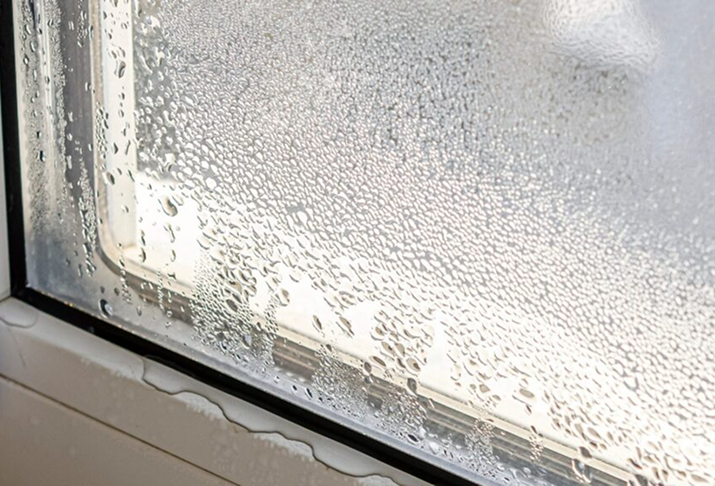
Condensation happens when moisture in indoor air meets a sufficiently cool surface and changes into liquid water.
During monsoon, you may notice droplets forming on the inside of the window glass or around frame edges.
Condensation itself does not necessarily mean that rainwater is leaking through the window. However, if droplets repeatedly wet the frame, sealant, curtains, or nearby walls and those materials remain damp, the risk of mold increases.
EPA specifically advises responding quickly when condensation or moisture collects on windows.
3. Blocked Sliding Window Tracks
Sliding windows are designed to collect and redirect some rainwater through drainage paths.
Problems can occur when tracks or drainage openings become blocked by dust, insects, leaves, paint, construction debris, or accumulated dirt.
Windoorkrafts explains that well-designed window systems use tracks and weep holes to allow collected rainwater to move outward instead of remaining inside the frame.
When water stays in the sill for extended periods, the surrounding dirt, sealant, plaster, or other materials can remain damp and develop an unpleasant smell or mold.
Related Article, Do Sliding Windows Leak During Monsoon? Causes & Prevention
4. Rainwater Seepage Around the Frame
Sometimes the problem is not condensation but actual rain penetration.
Water can potentially enter around a window because of deteriorated exterior sealant, gaps between the frame and wall, incorrect installation details, damaged seals, poorly functioning drainage, or other defects in the surrounding opening.
Windoorkrafts describes high-performance rain-management systems as using features such as gradient tracks, weep holes, gaskets, and drainage channels to move water away from the interior.
Related Article, How High-Performance Windows Prevent Rain Seepage
5. Damp Walls Around the Window
Not every damp patch beside a window originates from the window itself.
Exterior-wall cracks, roof leakage, plumbing problems, or moisture moving through surrounding building materials can also create damp areas near a frame.
A window should therefore be inspected together with the surrounding wall rather than considered in isolation.
Condensation or Rain Leakage: How Can You Tell the Difference?
The timing and location of moisture can provide useful clues.
What You Notice | More Likely Condensation | More Likely Rain Seepage |
Droplets mainly on interior glass | Common | Less typical |
Moisture appears without rain | Common | Unlikely |
Dampness increases during heavy rain | Possible | Strong indication |
Water repeatedly collects in tracks | Possible | Check drainage |
Damp plaster beside frame | Possible | Possible |
Very high indoor humidity | Strong clue | Not required |
Damaged exterior sealant | Not primary cause | Strong clue |
Blocked weep/drainage holes | Not primary cause | Possible contributor |
This table is only an initial diagnostic guide. Condensation and rainwater infiltration can sometimes occur at the same window.
Does uPVC Prevent Mold?
uPVC window frames can be easy to clean and maintain, but no window-frame material can prevent mold if moisture is continually present around it.
Mold can grow on dust and other organic material accumulated on surfaces, as well as on adjoining paint, plaster, fabrics, and some sealants.
Therefore, spotting mold around a uPVC window does not automatically mean that the uPVC material itself is deteriorating.
A Windoorkraft window should instead be viewed as part of a complete moisture-management system that includes the profile, glass, gaskets, drainage, locks, perimeter sealing, wall opening, and installation.
How Can You Prevent Mold and Musty Smells Around Windows?
Prevention starts with moisture control.
Keep Tracks and Drainage Holes Clean
Inspect sliding tracks regularly, especially before and during the rainy season.
Remove accumulated dirt and make sure drainage paths remain unobstructed. Proper drainage helps prevent water from sitting unnecessarily inside the sill. Windoorkrafts identify drainage and strong sealing as important parts of rain-resistant window design.
Dry Wet Areas Quickly
Do not allow water to remain around the sill, curtains, frame corners, or nearby wall surfaces for several days.
EPA recommends drying wet or damp materials within roughly 24–48 hours where possible to reduce the opportunity for mold growth.
Improve Indoor Airflow
Keep furniture and heavy curtains from permanently blocking airflow around a damp window.
Use appropriate ventilation in kitchens and bathrooms and consider air-conditioning or a dehumidifier when indoor humidity remains high. EPA recommends reducing humidity through ventilation, exhaust fans, air conditioning, or dehumidification as appropriate.
Monitor Indoor Humidity
A hygrometer can help identify whether the room consistently stays humid.
If condensation frequently appears on windows even when it is not raining, excessive indoor humidity may be contributing to the problem.
Inspect Seals and Frame Joints
Check the perimeter of the window for cracked, loose, missing, or deteriorated sealant.
Also inspect visible gaskets and frame joints.
Repeatedly applying sealant without identifying the actual leakage path is not a reliable long-term solution.
Check Curtains and Blinds
Wet or damp curtains can develop odor and mold independently of the window.
Allow fabrics to dry and maintain some air circulation between the window and curtain during periods of high humidity.
What Is a Practical Monsoon Window-Maintenance Routine?
A simple routine can prevent many moisture problems.
Before heavy rains begin, clean the frame and tracks, inspect drainage openings, examine exterior sealant where safely accessible, and check whether the window closes correctly.
During periods of frequent rain, look for standing water after a storm and dry indoor condensation when it appears.
After heavy wind-driven rain, inspect the corners of the frame and surrounding wall. If the same spot repeatedly becomes wet, investigate the cause rather than assuming it is normal monsoon behaviour.
Related Article, Rainproof Windows for Hyderabad Homes
A Common Real-World Example
Consider a bedroom with a sliding window covered by thick curtains.
During a rainy week, the room remains closed for much of the day. Humidity rises, condensation forms on the glass overnight, and dust has accumulated in the bottom track.
The curtain restricts airflow around the window, so the track and nearby painted sill dry slowly.
After several days, the homeowner notices an earthy smell and dark spotting near one corner.
This is an illustrative scenario rather than a Windoorkrafts customer case. It shows why mold is often the result of several small moisture-related factors acting together, rather than one dramatic leak.
Cleaning the visible spots may temporarily improve the appearance, but the problem can return if humidity, condensation, drainage, and drying are not addressed.
How Should Small Areas of Mold Be Handled?
The first priority is to correct the moisture source.
For mold on hard surfaces, cleaning methods depend on the extent of the problem and the material involved. CDC advises using appropriate protective measures during mold cleanup and warns never to mix bleach with ammonia or other cleaners.
If mold has affected absorbent wall material, keeps returning after cleaning, appears over a large area, or is linked to significant water damage, professional assessment may be appropriate.
The central principle remains the same:
Removing visible mold without stopping the moisture source does not solve the underlying problem. EPA describes moisture control as the key to mold control.
Common Mistakes to Avoid
One of the most common mistakes is immediately assuming that every wet window is leaking. Condensation can create very similar symptoms.
Another is sealing drainage openings because water is visible in the track. Those openings may actually be designed to move water outside.
Painting over mold without resolving dampness is also ineffective. CDC advises fixing the water problem and cleaning the mold before painting or caulking affected areas.
Finally, avoid judging a window’s monsoon performance only by its frame material. Drainage, gaskets, glass, fabrication, installation, and frame-to-wall sealing also matter.
Frequently Asked Questions
Why do my windows smell musty only during monsoon?
Answer: Monsoon weather can increase moisture around windows through humidity, condensation, rain seepage, or slow drying. Damp dust, sealant, curtains, walls, or other nearby materials may then develop mold or an earthy odor. Finding and correcting the moisture source is more effective than masking the smell.
Why does black mold appear around the edge of a window?
Answer: Window edges and corners can remain damp because of condensation, trapped dirt, weak airflow, or water infiltration. Check indoor humidity, clean the frame and tracks, inspect drainage openings and seals, and determine whether moisture appears during rainfall or independently.
How can I stop mold from returning around my window?
Answer: Remove the moisture source first. Keep indoor humidity controlled, improve airflow, clean window tracks and drainage paths, dry wet surfaces promptly, repair persistent leaks, and inspect deteriorated perimeter sealing. Moisture control is the most important part of preventing recurring mold.
Can blocked drainage holes cause a musty smell?
Answer: Blocked drainage can allow rainwater to remain longer in window tracks. Standing moisture combined with accumulated dust and nearby absorbent materials can contribute to damp odors and mold. Good window systems use drainage tracks and weep holes to direct collected rainwater outward.
Should I replace a window if mold keeps coming back?
Answer: Not necessarily. First determine whether the moisture comes from condensation, blocked drainage, damaged perimeter sealing, wall seepage, or another source. When comparing replacement options or Windows Suppliers in Telangana , focus on the complete installed system—including drainage, sealing, glazing, hardware, and professional installation—rather than frame material alone.
Conclusion
Mold and musty smells around windows during monsoon are usually signs that moisture is remaining somewhere for too long.
High indoor humidity, condensation, blocked drainage tracks, damaged seals, rain seepage, damp surrounding walls, and restricted airflow can all contribute.
For a Windoorkraft window, prevention should focus on the entire opening—not only the visible frame. Keep tracks and drainage holes clear, control humidity, dry wet surfaces promptly, inspect seals, and investigate recurring dampness.
A musty smell that repeatedly returns should not simply be covered with fragrance or paint. Find the moisture source first.
If the problem continues despite basic maintenance, or significant dampness is visible inside surrounding walls, having the window and building opening professionally inspected can help identify whether the issue lies with condensation, installation, drainage, sealing, or the surrounding structure.

Pingback: Aluminium Windows Maintenance Guide for Hyderabad Homes